
Exploring the Beauty of Transience and Memory: A Deep Dive into the Ethereal World of Dutch Photographer Paul Cupido
You grew up on the beautiful island of Terschelling. How does your upbringing influence your perspective on the world and subsequently, your photography?
The more I reflect on my personal and creative journey, the more I wonder which of my personal patterns, tastes, and traits can be directly linked back to my island roots. Of course, as a born and bred islander, it’s difficult to imagine growing up in a city (or the ‘mainland’ as we call it) or how it may have shaped me differently. In retrospect of course I can see that there are some very obvious differences, the biggest being the presence of nature and the fact that we islanders are only a tiny part of something much bigger. The sea close to our family home has an enormous tidal range, with the water ebbing and flowing twice a day. At low tide, you can walk out across the mudflats and witness a whole myriad of life – a lavish buffet for the huge throngs of birds that flock there. Then at high tide, the same area is completely submerged by two meters of water. During our long childhood summers, we would lose all sense of time, sometimes spending so long at the shore that the sea had time to rise, fall, and rise again. The lighthouse would also flash into my childhood bedroom window every four seconds, and my grandparents used to tell me that it was watching over us. These kinds of experiences meant that from a very young age, you were acutely aware of the perpetual rhythms of the island: the cosmic phenomenon of the moon controlling the tides, the natural daily cycles, and the passing of the seasons. Nature is all around you so you are always part of it. That enduring sense of rhythm has certainly influenced my work as an artist.

The small island where I grew up is only accessible by boat and you literally can see where the land ends. This isolation creates its own kind of freedom through a self-sufficient ecosystem. The world’s problems seem far away – we don’t even have traffic lights or traffic jams. I carry the island with me, and it means I observe the world with a strong connection to the changing seasons and the notion that everything in life is part of a cycle. Of course, this is my experience and I can’t say whether or not that is different for someone who has grown up on the mainland. As an islander, I have always found the city to be a fascinating place, especially when I was younger. I recently read that there is no measurable relationship between someone’s personality and whether they have grown up in the city or in the countryside, however, researchers have found that city dwellers are generally better able to deal with stress and have a higher pace of life than ‘outdoor people’. But this frenetic energy also means that the city can knock people out of balance. Nature is a mirror that feeds all the senses, and the awareness of the senses is a prerequisite for being able to create. I personally like to spend part of my time in the city with all its energy and impulses, but then it’s important for me to escape back to nature again to find my own harmony. We have a strong seasonal tourist industry on the island which means that during the winters it is very quiet. The sense of boredom can be a powerful motor for creativity where the absence of distraction leads to pure concentration. Insularity means a few different things to me. Islanders can sometimes be a bit narrow-minded in their worldview, but on the other hand, they can be very open-minded. Their seafaring nature, the visiting tourists, and the free-thinking spirits (freebooters) mean that there is a unique atmosphere. What inspires me about the island is that it is an independent entity that represents a microcosm of the wider world. This translates into my work in the way I like to strip things down into smaller, more manageable and comprehensible elements. I now also experience that same feeling in Cadaqués, which has also been isolated for a long time.

Could you share with us the story of when and how you first approached photography and the arts? Was there a specific moment or influence that sparked your interest?
I worked from my own studio as a sound designer for about 25 years. I was creating audios for films and commercials. The pressure of the relentless deadlines was a lot to handle and eventually, I had no choice but to stop. I suddenly found I was incapable of functioning properly. Today perhaps people would call it a burnout. I stopped working with sound entirely and at a very low point, I remember picking up a very basic camera. Experimenting with it brought me back to the present and it was a healing, freeing, and somehow pioneering experience.

“Searching for Mu” is an ongoing project and it has become synonymous with your creative journey. Could you explain how the concept of ‘mu’, or nothingness, resonates with you and how it is reflected in your work?
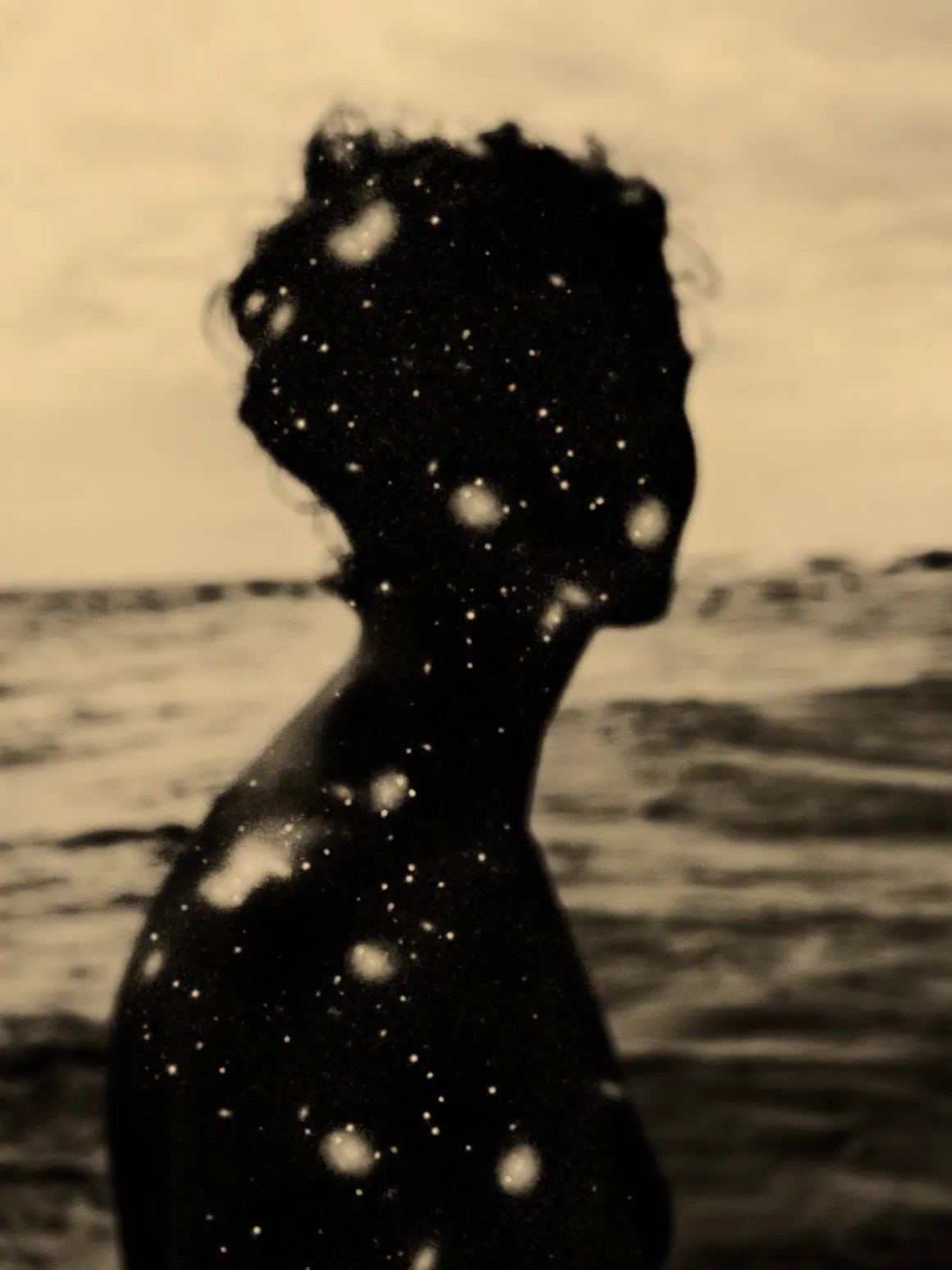
Mu is not an easy concept to translate and it is still an ongoing mystery to me. In a sense, ‘searching’ for Mu is not really possible, as it is intangible and ever-present, however you are able to discover it. To me it is a zero state of mind, existing entirely in the present and devoid of ego. I like to draw comparison with an empty space that is full of potential. Freeing space of its noise means that inspiration is able to flow in. It is like a law of nature that emptiness wants to be filled. I try to reach this state in my work, for example by traveling as a minimalist, so that my mind is clear and therefore also totally receptive. My images also often contain a lot of empty space, which is also my way of searching for Mu – for essence.

In previous interviews, you stated that your work is heavily influenced by your Dutch roots and your fascination with Eastern philosophies. How do you manage to intertwine these two aspects in your work?
There is a long history and bond between the Netherlands and Japan that began around 1609 when our two countries began trading with one another. In fact, from the mid 1600s spanning two centuries, the Netherlands was the only Western country exclusively allowed to trade with Japan. There is an etching by Rembrandt of his son Titus from c.1656 printed on handmade Washi paper from the Echizen region. I find it fascinating that already so far back in history there was such great admiration for this special Japanese paper among some of our greatest Dutch artists. Washi paper has been, and still is, famous for its quality, longevity, and unique way of absorbing light.
My work is greatly influenced by Japanese aesthetics, but also their way of working, dedication, and artistic approach. I try to embrace the philosophy of Haiku: staying fully focused on the present while being open to a sudden moment of enlightenment. My Dutch Calvinist roots are similarly sober, minimalist, and unpretentious. I believe that there is a natural harmony between our cultures and that can lead to some truly interesting interactions.
Having published seven photo books so far, can you describe your approach to the editing process? How do you decide which images make the final cut and how do you sequence them? Secondly, how do you go about selecting the type of paper for your books? Can you share with us the thought process behind these choices and their significance in enhancing the viewer’s experience of your work?
For me, the first stage is in fact the photography itself. I don’t plan ahead or prepare in fine detail, as I prefer to completely immerse myself in a place, intuitively collecting as much material and as many impressions as possible. I then like to allow some time to pass for contemplation and also to distance myself a little from the images themselves. This means I can begin the selection and pairing process with a more objective eye. Next – When I still have a relatively large number of images works, I begin sequencing and the final editing down. I really like to do that with Akiko Wakabayashi, the graphic designer I made the three Artist books with, or with Ellen Sanders, a very skilled editor who is able to make unique combinations. I play around with small prints of my images, laying them across the ground. There’s always a moment of euphoria when two or three images that were taken separately suddenly connect to form a kind of visual poem. Once the sequencing is done, I approach designing the book as if it is a house for the composition to inhabit. This informs the dimensions, paper selection, binding, etc. It is a matter of tuning into what the work itself wants to be. For example for my book 4am, Akiko and I selected beautiful paper from the same place the photos were taken in Japan. This particular paper is very thin, and absorbs the light beautifully, which is in unity with the project theme: the changing light that occurs around 4 am. I also believe in the tactile value of paper to enhance the reader’s experience. For example, I think it is fantastic to go from a somewhat smoother paper to something much rougher, in symbiosis with the visual narrative. There is also the sound and scent of the paper, all wonderful stimuli to elevate a book into an art object.
In which ways has your work evolved over the years, and where do you see it going in the future?
When I first started, my work was very raw. I was (and still am) very much charmed by the provoke movement and the “are-bure-boke”, which is clearly visible in my first publications. My work now has a lighter and softer poetic visual language. In the future, I want to work towards a very minimalistic form, in my personal attempt to capture the essence of Mu.

Throughout your artistic journey, has there been any specific moment or event that has significantly shaped your career? Is there a particular memory that stands out, something that you look back on fondly, or as a turning point in your artistic development?
My personal ‘art-changing’ moment happened in Tokyo when I participated in a workshop with Antoine d’Agata in 2016. I had to work at night and rely entirely on my instincts and the impressions of the city. The guidance of the teacher, along with the dynamics of the group and being in Japan for the first time, was so influential on me that it has permanently shaped my way of working. For the first time, I made purely autonomous work.

Are there any upcoming projects or series you can give us a sneak peek into?
I’m currently working from the art residency of the most charming InCadaqués Photo Festival in Cadaqués and Port Lligat where the divine spirits of Dalí and Gala are still very present. This is together with Parisienne artist Anna Muller. My personal output is a collection of playful images, titled ‘Swoon’. As I work, I’m following the philosophy of Haiku by opening my mind and approaching a place with childlike wonder, photographing purely on impulse. This together with listening closely to the landscape is fundamental to my process. In December we will work from the Okinawa Islands in Japan, and I’m planning a new book.

You graduated ‘Cum Laude’. Do you have any advice for young artists trying to navigate the world of fine art photography?
I don’t believe that photography is a competition but I do believe that you have to fully commit yourself to what you want to make and show. Hyper-focus, listen to your heart and follow the path that your intuition leads you to.


